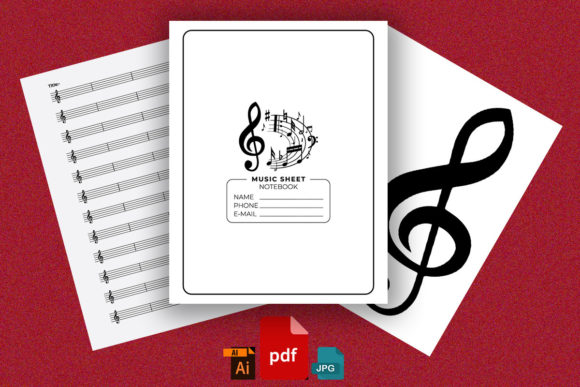
KDP Sheet Music Notebook Design: Technical Specifications and Creative Applications
The landscape of self-publishing has evolved significantly, moving beyond simple text-based manuscripts to include highly specialized functional books. Among these niche products, the KDP Sheet Music Notebook Design stands out as a vital resource for musicians, composers, and educators. Unlike standard lined journals, creating a manuscript for musical notation requires precise adherence to technical standards to ensure usability. When evaluating or creating a KDP Interiors Sheet Music Notebook Design, understanding the specific product parameters is not merely a suggestion; it is the foundation of a successful print-ready file.
This comprehensive guide explores the practical realities of working with an 8.5×11 inch, 123-page sheet music notebook template. We will examine why specific bleed settings matter, how to utilize multi-format source files effectively, and what creators should expect when transitioning from digital design to physical print. Whether you are a KDP publisher expanding your catalog or a musician seeking the perfect composition book, this analysis provides the necessary context to make informed decisions.
Understanding Core Product Specifications
The utility of any sheet music notebook relies entirely on its dimensions and layout integrity. The specified product information outlines a trim size of 8.5×11 inches, which is the industry standard for letter-sized documents in North America. This dimension is critical because it mirrors the size of standard printer paper used by students and professionals alike, ensuring that the notebook fits seamlessly into existing binders, folders, and music stands.
A defining characteristic of this specific design is the No Bleed setting. In printing terminology, "bleed" refers to artwork that extends beyond the trim edge of the page. However, for interior pages of a sheet music notebook, a no-bleed configuration is often preferable and safer for several reasons:
- Gutter Safety: Musical staves must remain centered and readable. A no-bleed setup ensures that staff lines do not drift into the binding gutter, which can happen if margins are miscalculated in a bleed document.
- Printing Consistency: Amazon KDP’s printing process allows for slight mechanical shifts. By keeping all staff lines and headers within a safe margin zone (typically 0.375 inches from the edge for no-bleed interiors), you eliminate the risk of content being trimmed off.
- User Annotation Space: Musicians frequently write notes, fingerings, and dynamic markings in the margins. A no-bleed design inherently preserves this white space, enhancing the functional value of the notebook.
The page count of 123 pages represents a strategic balance. It is thick enough to serve as a substantial semester-long journal or a complete collection of compositions, yet thin enough to maintain a flexible spine that lays relatively flat when opened. For publishers, this page count also hits a sweet spot for production costs versus perceived value.
Navigating File Formats and Print Readiness
One of the most significant advantages of acquiring a professional KDP Sheet Music Notebook Design package is the inclusion of multiple source formats. The product description highlights availability in AI, EPS, PDF, JPG, and MOCKUP files. Understanding the distinct purpose of each format prevents workflow bottlenecks.
The Role of Vector Source Files (AI and EPS)
Adobe Illustrator (AI) and Encapsulated PostScript (EPS) files are vector-based. This means the staff lines, clefs, and barlines are mathematical paths rather than pixel grids. For a creator looking to customize their notebook, these files are indispensable. You can adjust the spacing between staves, change the font of the header, or add custom branding without losing resolution. Even if you do not plan to modify the design immediately, retaining these vector files ensures future-proofing. Should KDP update their margin requirements or should you wish to create a spiral-bound version through a different printer later, the vector source allows for instant adaptation.
The Importance of High-Quality Print Ready PDF
While source files offer flexibility, the High-Quality Print Ready PDF is the operational workhorse. This file should be flattened, embedded with fonts, and exported at 300 DPI or higher. When uploading to KDP, this single PDF file serves as the final contract between your design and the printing press. It eliminates variables; what you see in the PDF is exactly what appears on paper. Users should always verify that this PDF matches the 8.5×11 trim size exactly, with no extra crop marks or registration marks included, as KDP’s automated systems can sometimes misinterpret these artifacts.
Visualizing with Mockups
The inclusion of a MOCKUP file bridges the gap between production and marketing. Before listing a sheet music notebook, creators need to visualize how the cover interacts with the interior. More importantly, customers cannot physically flip through a digital product. High-resolution JPG mockups allow you to showcase the interior layout on sales pages, demonstrating the quality of the staff lines and the clarity of the print. This visual proof is often the deciding factor for buyers comparing multiple options.
Practical Applications and User Scenarios
The versatility of a well-executed KDP Interiors Sheet Music Notebook Design extends across various user demographics. Recognizing these use cases helps in tailoring metadata, descriptions, and even minor design tweaks to better serve the end consumer.
For Music Educators and Students
In academic settings, consistency is key. A standardized 8.5×11 notebook with 123 pages serves as an excellent theory workbook or composition journal. Teachers often require students to transcribe exercises or write original melodies. The no-bleed format ensures that hole-punching for binders does not destroy the musical content. Furthermore, the ample page count supports a full curriculum cycle without requiring multiple volumes.
For Professional Composers and Arrangers
While software like Sibelius or Dorico dominates professional engraving, many composers still prefer hand-sketching ideas before digital entry. A high-quality printed notebook offers a tactile creative space free from screen fatigue. The specific dimensions of this design accommodate grand staff systems comfortably, allowing for complex orchestral sketches or piano reductions. Professionals value the "amazing and creative" aspect mentioned in product specs because it implies the staff spacing is proportional and aesthetically pleasing, not just functionally adequate.
For Self-Publishers and Low Content Creators
For those building a business around KDP, this design represents a scalable asset. Because the file is ready to print, it reduces time-to-market significantly. However, success in this niche requires differentiation. Publishers should consider using the editable AI/EPS files to create variations—perhaps adding chord chart sections, lyric lines, or tablature grids—to target specific sub-niches like guitarists or songwriters, rather than competing solely with generic manuscript paper.
Evaluating Suitability and Limitations
While this KDP Sheet Music Notebook Design offers robust features, potential users must approach it with realistic expectations. No single template solves every problem, and understanding limitations is as important as recognizing strengths.
Considerations for Binding and Gutter
Even with a no-bleed setting, the physical binding of a 123-page book creates a gutter. Users should test print a few pages at home before committing to a large batch or final upload. Check specifically for the inner margin clearance. If the staff lines feel too close to the spine during actual use, the editable source files provide the remedy. Adjusting the master page in Illustrator to shift content outward by 0.1 inches can drastically improve the user experience without requiring a complete redesign.
Paper Quality Expectations
KDP standard color or black-and-white paper is suitable for pencil notation and ballpoint pens. However, it is not archival-grade art paper. Markers, heavy gel pens, or watercolors may bleed through or feather. Creators marketing this notebook should be transparent about intended writing instruments. Positioning the product as a "sketch and study" journal rather than a "final presentation" manuscript manages customer expectations and reduces negative reviews related to paper weight.
Digital vs. Physical Workflow
It is worth noting that while JPG and PDF files are included, this product is primarily designed for physical print. Using these templates for digital tablet notation (like on an iPad with GoodNotes) is possible but may require resizing or cropping to fit screen aspect ratios. The 8.5×11 ratio does not perfectly match standard tablet screens, potentially leaving unused borders. Users seeking digital-first solutions should be aware they may need to adapt the provided files.
Best Practices for Implementation
To maximize the value of this amazing and creative print-ready file, follow these implementation guidelines:
- Verify Before Upload: Always run the PDF through KDP’s Previewer tool. Check specifically for warnings regarding margins and embedded fonts. Even a "ready to print" file should be validated against current platform specifications.
- Customize Metadata: Do not rely solely on the generic title. Use the editable files to add a unique subtitle or series name to the cover. This aids in discoverability and brand building.
- Leverage the Back Page: The product includes a cover back page. Utilize this space strategically. Add a table of contents, a reference chart for musical symbols, or space for the owner’s contact information. This adds tangible utility that distinguishes your notebook from competitors.
- Maintain File Integrity: Keep the original AI and EPS files organized in a dedicated project folder. As KDP updates its publishing guidelines, having access to the raw vectors ensures you can quickly regenerate compliant PDFs without starting from scratch.
Conclusion
The KDP Sheet Music Notebook Design described here represents more than just a collection of digital files; it is a foundational tool for both creators and consumers in the musical ecosystem. By adhering to strict 8.5×11 no-bleed specifications and providing versatile format options, this product addresses the technical demands of print-on-demand publishing while serving the artistic needs of musicians. Whether utilized as a direct publishing asset or a personal composition journal, understanding the interplay between file formats, physical constraints, and user application is essential. Success lies not just in downloading a ready-to-print PDF, but in comprehending the nuances that transform a digital template into a functional, high-quality musical instrument in book form.